


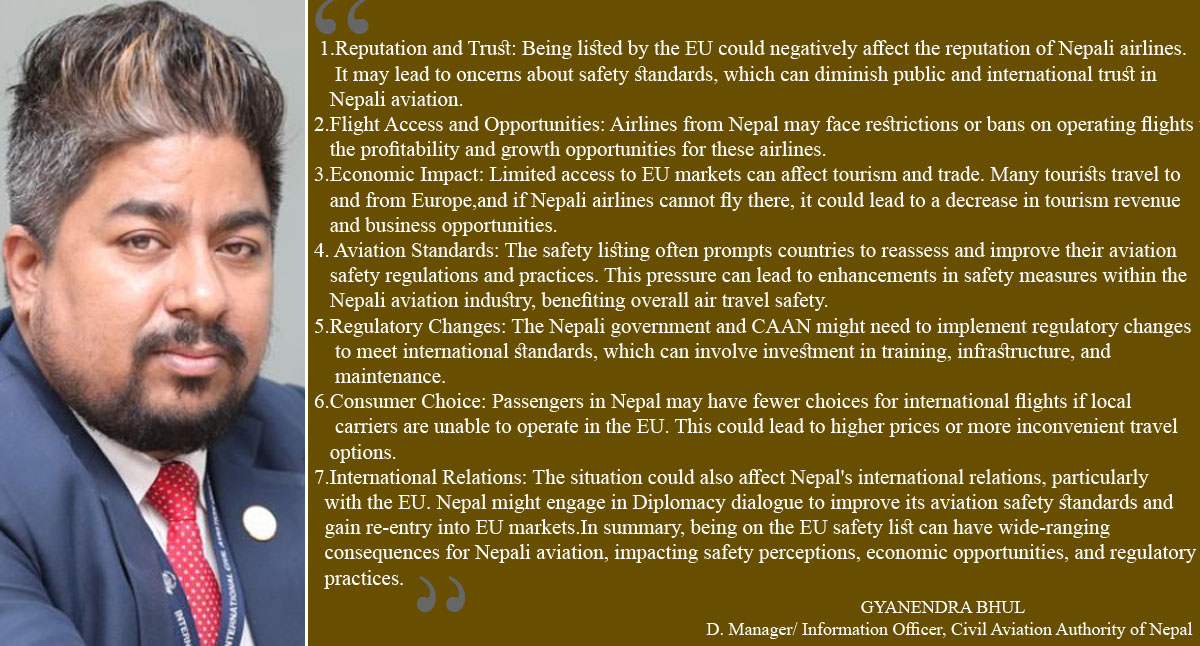
GYANENDRA BHUL
D. Manager/ Information Officer
Civil Aviation Authority of Nepal
As per EU, alike before, the Legal Notice made public on 13 December 2024 has contained all air carriers of Nepal in Annex -A of Air Safety List, proving futile the CAAN efforts more than 10 years for exclusion. Commission Regulation (EU) No 452/2014 requires all Third Country Operators to hold a “Part-TCO” authorization from the European Union Aviation Safety Agency (EASA) prior to undertaking any commercial flight to, from, or within the Union. EASA and the European Commission ensures that the EU Air Safety List and Part-TCO are closely coordinated and, Part-TCO is equivalent to the operating authorisation of other countries in the context of commercial air linkages as per Air Service Agreements.
Nepal’s aviation sector plays a crucial role in the country’s economy, contributing approximately 7% to GDP and supporting the tourism industry through instrumental share of mountain tourism, which drives millions of dollars in revenue to governmental & non-governmental sectors. However, a significant barrier looms over this sector: the European Union’s operational ban on Nepali airlines. This ban, more strategical less operational, has far-reaching consequences that impact not just the airlines but also the economy, employment, and international standing of Nepal and becoming baking widget for the dwellers of aviation fraternity.
History of the Operational Ban
The EU’s operational ban on Nepali airlines has a complex history, first enforced in 5 December 2013 following the below-average performance of Nepal during ICAO ICVM 2013 as 55 Effective Implementation rate instead of 60 global averages, out of 100. This action stemmed from a series of safety audits conducted by the European Aviation Safety Agency (EASA) in line with USOAP in AD Years; 2009, 2013 & 2017. Over the years, the ban has repeatedly highlighted deficiencies that have yet to be adequately addressed provided that, one reason showing of another one within. The EU, in its own way, has pointed out several safety concerns that led to the ban, including:
- Fatal Accidents & Audit Failures: Data from ICAO USOAP audits show a high rate of compliance with international safety standards but exhibits high rate of accident per 100 flights, moving in reverse direction of aspirational global target of zero fatal commercial occurrences by 2030 & beyond. (ICAO, GASP)
Factors behind the Fatal Accidents in Nepal
Fatal air accidents in Nepal have surged, with over 100 accidents recorded in the last few decades. This alarming statistic emphasizes the gravity of aviation safety in the region. The challenging geography of Nepal, characterized by its rugged mountains and unpredictable weather, greatly affects aviation operations. This article explores the key causes behind fatal air accidents in Nepal, shedding light on the terrain, human factors, aircraft limitations, regulatory issues, and socioeconomic factors.
- Terrain and Weather Challenges
- Mountainous Terrain
The Himalayas dominate Nepal’s landscape, creating significant challenges for pilots. Navigating through mountainous regions increases the risk of accidents. For instance, the 2016 Tara Air crash involved steep terrain and limited maneuverability. Studies show that over 60% of Nepal’s air accidents are terrain-related, often because pilots miscalculate altitude in mountainous areas.
- Inclement Weather
Weather in Nepal can change suddenly, particularly during the monsoon season. Sudden storms frequently catch pilots off guard, leading to critical situations. Many Air crashes are evident of how inclement weather contributed to a fatal accident. Experts often highlight the difficulties in weather forecasting due to the region’s unpredictable patterns.
- Visibility Issues
Fog, snow, and low clouds are common in Nepal’s aviation environment. These conditions drastically reduce visibility, affecting pilot decision-making. Statistics indicate that low visibility conditions have been a contributing factor in 40% of air accidents in Nepal. Real-world examples demonstrate the dangers pilots face when flying under such conditions.
- Human Factors
- Pilot Error
Human error remains a leading cause of air accidents in Nepal. Issues such as pilot fatigue, inadequate training, and poor decision-making contribute significantly to incidents. Records show that pilot error is involved in nearly 50% of accidents. Experts point to the need for stricter training standards to improve overall pilot performance.
- Air Traffic Control
Air traffic control (ATC) systems in Nepal face numerous challenges. Communication breakdowns and coordination issues have led to several incidents as contributary factor. For instance, a 2018 collision near Tribhuvan International Airport raised concerns about ATC effectiveness. Statistics reveal a notable increase in accidents tied to ATC failures.
- Maintenance Issues
Aircraft maintenance plays a crucial role in aviation safety. In Nepal, inadequate maintenance practices often lead to mechanical failures. Data suggests that about 30% of air accidents relate to maintenance issues. These incidents underline the need for stricter enforcement of maintenance standards.
- Aircraft and Infrastructure Limitations
- Aging Aircraft
Older aircraft models used in Nepal’s aviation sector can pose serious risks. Many airlines operate aging fleets, which can lead to mechanical problems. Statistics show that older aircraft are involved in 20% of accidents. This highlights a pressing need for fleet modernization to ensure safer travel.
- Inadequate Infrastructure
Nepal’s airport infrastructure struggles to meet the demands of its aviation sector. Many airports lack essential navigational aids and emergency response systems. For example, the airport in Lukla, known for its challenging conditions, often faces capacity issues. These limitations hinder effective search and rescue operations during emergencies provided that CAAN is maximizing the airport capacity by mobilizing its majority of capital expenditure.
- Lack of Technological Advancement
The gap in aviation technology compared to global standards is significant. In, Nepal outdated systems for navigation and safety impede effective operations. Statistics indicate that 70% of the aviation technology in use is over ten years old, hampering improved safety protocols.
Statistical Analysis of Air Accidents in Nepal
- Accident Rates Over Time
A timeline of air accidents in Nepal reveals fluctuations. In the early 2000s, incidents were common, with an average of five accidents per year. However, in recent years, that number has decreased to around three per year, showing some improvement by Civil Aviation Authority of Nepal and its fraternity
- Types of Accidents
Air accidents can occur due to various reasons. A breakdown of data shows:
- Pilot Error:45%
- Mechanical Failure:35%
- Weather-Related:30%
- Other Causes:10%
This reveals that improving pilot training could significantly reduce accident rates.
- Fatality Rates
The fatality rate in Nepal’s aviation sector has been concerning. An average of 25 lives lost per accident highlights the severe consequences of these incidents. Despite improvements, the overall safety record remains a pressing issue.
Impact on Nepali Airlines
Financial statistics indicate that Nepali airlines have faced significant losses, with an estimated $300 million lost in potential revenue since the operational ban. This situation has led to critical job insecurity for thousands of employees in the aviation sector of Nepal. The European Union’s safety listing can have significant impacts on Nepali aviation. Here are some key points to consider:
- Reputation and Trust: Being listed by the EU could negatively affect the reputation of Nepali airlines. It may lead to concerns about safety standards, which can diminish public and international trust in Nepali aviation.
- Flight Access and Opportunities: Airlines from Nepal may face restrictions or bans on operating flights to EU countries. This limitation reduces market access and could impact the profitability and growth opportunities for these airlines.
- Economic Impact: Limited access to EU markets can affect tourism and trade. Many tourists travel to and from Europe, and if Nepali airlines cannot fly there, it could lead to a decrease in tourism revenue and business opportunities.
- Aviation Standards: The safety listing often prompts countries to reassess and improve their aviation safety regulations and practices. This pressure can lead to enhancements in safety measures within the Nepali aviation industry, benefiting overall air travel safety.
- Regulatory Changes: The Nepali government and CAAN might need to implement regulatory changes to meet international standards, which can involve investment in training, infrastructure, and maintenance.
- Consumer Choice: Passengers in Nepal may have fewer choices for international flights if local carriers are unable to operate in the EU. This could lead to higher prices or more inconvenient travel options.
- International Relations: The situation could also affect Nepal’s international relations, particularly with the EU. Nepal might engage in Diplomacy dialogue to improve its aviation safety standards and gain re-entry into EU markets.
In summary, being on the EU safety list can have wide-ranging consequences for Nepali aviation, impacting safety perceptions, economic opportunities, and regulatory practices.
Analyzing & Resolving of the Root Causes
Reducing fatal air accidents in Nepal involves a multifaceted approach that includes regulatory, operational, and educational measures.
- Strengthening Regulatory Framework
Enhance the capacity of the Civil Aviation Authority of Nepal (CAAN) to enforce stricter safety regulations and standards. Regular audits and inspections of airlines, aircraft, and maintenance facilities.
- Improving Pilot Training
Invest in advanced training programs for pilots, including simulator training for emergency situations specific to Nepal’s unique topography and implement regular refresher courses to keep pilots updated on the latest safety practices and procedures.
- Upgrading Navigation and Communication Technology
-Enhance air traffic control systems with modern technology to provide better flight monitoring and guidance, especially in remote areas. Has increase the availability of navigation aids in mountainous regions to assist pilots during challenging weather conditions.
- Enhancing Aircraft Maintenance Standards
Ensure stringent maintenance protocols are followed by airlines, including regular checks and updates on older aircraft. Promote the use of newer aircraft models that come equipped with enhanced safety features by reviewing Civil Aviation Policy – 2063 and adjoined Laws.
- Implementing Emergency Response Plans
Develop comprehensive emergency response plans that include coordination between aviation authorities, local governments, and emergency services. Conduct regular drills to prepare for various scenarios of air accidents.
- Promoting Safety Culture
Foster a culture of safety within airlines by encouraging open reporting of safety concerns without fear of retribution and organize workshops and seminars to raise awareness among staff and the public about aviation safety.
- Improving Weather Forecasting and Reporting
Enhance the quality and accessibility of weather forecasts, especially for mountainous areas where conditions can change rapidly. Provide pilots with real-time weather updates and advisories before and during flights by increasing the Capacity of DHM, Nepal.
- Public Awareness Campaigns
Conduct campaigns to educate the flying public about safety measures and expectations when traveling by air. Share information about the importance of critical safety instructions and protocols during flights.
- International Collaboration
Collaborate with international aviation bodies like the International Civil Aviation Organization (ICAO) to adopt best practices and safety measures from other countries.Participate in regional safety forums to learn from experiences and challenges faced by neighboring countries.
Nepal’s Response and Reform Efforts
- Government Initiatives
In response to the EU’s concerns, the Nepali government has launched several initiatives:
- Regulatory Reforms: Strengthening CAAN’s authority, Functionality and accountability measures.
- Safety Audits: Increased frequency of internal safety assessments and audits of ICAO.
- Industry Collaboration
Nepali airlines are collaborating with CAAN and international aviation organizations to align with safety standards. This cooperation aims to enhance operational protocols and share best practices.
- Investment in Infrastructure
Significant investments are being made to upgrade critical infrastructure:
- New Terminals: Projects are underway to expand airport capacity of existing international and domestic airports.
- Modern Technology ANS: Implementation of advanced air traffic management systems to increase efficiency, from conventional radio aids to satellite based systems (RNAV, RNP-AR).
Predicting the Future of Nepali Aviation
With ongoing reforms, structural and operational, the timeline for lifting the ban could be optimistic. If Nepal effectively addresses these challenges, it may regain EU access within the next few years. The future of Nepali airlines hinges on embracing these changes. The EU’s operational ban on Nepali airlines presents a multifaceted crisis affecting the economy, employment, and international relations. The path to recovery is fraught with challenges but offers opportunities for growth. With commitment and collaboration, Nepal’s aviation sector can navigate this turmoil and emerge stronger, creating a brighter future for all stakeholders involved.